Monday, 9 May 2022

Rebecca Riots, Ceffyl Pren and the age of innocence


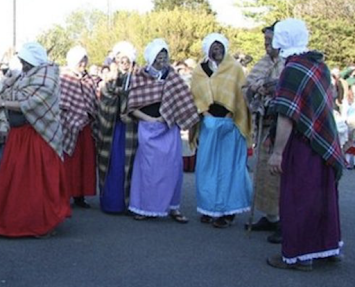
I have just been reading about the Carmarthen celebration (on May 1st) of the Rebecca Riots, in a somewhat strange artistic event in which three men dressed up as "female" rioters -- without a blackened face in sight.

This was in contrast to the 2014 celebrations in Efailwen:

https://www.bbc.co.uk/news/uk-wales-south-west-wales-27375757

Eight years ago, the BBC website covered the event, and published photos of men dressed in female garb, and with blackened faces and white linen bonnets.  That was fine, and was a pretty good representation of what went on in the Rebecca Riots and the Ceffyl Pren tradition that pre-dated the riots and continued for some time afterwards. It needs to be emphasised that the blackened faces had absolutely nothing to do with racism or racial stereotyping, and everything to do with hiding identities.  All of the rioters must have been familiar with the idea that (like chimney sweeps) black-faced men emerging from the west Wales coal mines at the end of their shifts were none too easy to recognize -- and so the tradition of blackening faces went along with the costumes and the straw hair, the bonnets and the aprons to ensure that bystanders could not put names to faces.  And it worked -- very few rioters were ever brought to justice.  

I can fully understand why the word "nigger" has effectively been banned from the English language, and why people on radio and TV nowadays refer obliquely to "the n-word" instead.  There is great sensitivity out there, and political correctness is everything -- while at the same time there is greater and greater tolerance of verbal obscenities, with swearing now so commonplace that it has become more than a little sickening........

Strange old world.


Saturday, 23 April 2022

Nineteenth century industrialisation in Pembrokeshire


A lot was going on in Pembrokeshire in the first part of the Nineteenth Century, when Martha Morgan was in her prime.  Plas Ingli and the estate, and Martha's life, were not much affected by the process of industrialisation, but now and then its effects appear in the stories.

Wilmot Gwynne, when he appears on the scene, has made his fortune in the copper industry of the Swansea area, and of course the theme of "Guardian Angel" is all to do with the voracious appetite of the iron industry monster -- which comes too close to home for comfort.......

Anyway, fascinating short summaries and great photographic illustrations are contained on this web site.  Well worth a browse........

 http://industrialgwent.co.uk/w-b12-pembroke/index.htm#porthgain

We are climbing Angel Mountain


I came across this rather splendid album from singer Rhys Williams, featuring Angel Mountain in the title and main track.  A great voice -- and his diction is excellent.  I hope the record becomes a great success for him........

 https://justlistentothis.co.uk/reviews/rhys-williams-climbing-angel-mountain/

You can also find the tracks on Spotify, by putting "We are climbing Angel Mountain" into the search box.

The recordings were made in 2016 and 2017.

Here is Rhys's web site:

http://www.rhyswilliamsmusic.com

The Angel Mountain iris


Not everybody knows this, but there is a gorgeous Japanese iris (you can get it from commercial growers) called "Angel Mountain".  Was its breeder inspired by Martha Morgan and her adventures?  Probably not, but it's a nice thought........

Friday, 22 April 2022

Carningli -- Brynach's shelter?


 Many thanks to Hugh Thomas for publishing this image in his recent drone footage of Carningli -- published on Preseli 360.  

It shows the very subtle semicircular "bank" of stones around the edge of the grassy hollow on the summit of the mountain.  According to legend, this is where St Brynach communed with the angels. It is quite possible that there was a rough shelter here, using the rocky outcrops for half of the circle and a little bank of boulders and stones for the other half, maybe with roof of supporting branches covered with rough thatch or bark and turfs.  Maybe it was horizontal, or maybe sloping. 

There have been no excavations here as far as we know.  But there has been intermittent occupation of the mountain down through the centuries -- so a shelter here could be Bronze Age, or Iron Age, or from the Age of the Saints, or even from the Middle Ages.  Maybe it was even built and rebuilt many times....... by people who needed to be up here for one reason or another......

Friday, 15 April 2022

To Paradise and Back


This is the web site devoted to telling the tale of the Hoole / Stephens family, as far back as we can trace it.  Many people have contributed to the collection of information.  Some of it is true, and some of it is probably mythology.  Maybe we will never know the full truth -- but it is an extraordinary story nonetheless.....

My mother Gwladys John (then Stephens) was born in Port Elizabeth in 1906, and her family returned to Wales in 1915.

You can click on this link:

 https://thesouthafricanconnection.weebly.com