Monday, 4 March 2019

Alexander Cordell -- a literary giant whose books sold by the million


Alexander Cordell shortly before his death in 1997

I discovered this interesting article from Carolyn Hitt about one of my literary heroes -- Alexander Cordell.  I knew that his books had sold in their millions, but I had not realised that the literary establishment in Wales had shunned him -- just as it has attempted to ignore other Welsh best-selling authors including Iris Gower and Catrin Collier.

Yes, his writing style was rather peculiar.  We might call it rough and even muscular, but it had great vitality and appeal.  His characters were rough and ready too, and not at all multi-dimentional.  But he knew how to spin a good yarn and how to grab the reader's attention.  One reason maybe why "the establishment" never warmed to him was his very strong socialist message and his portrayal of the class struggle.  He did have a tendency to portray the working class as heroes and the gentry as evil bastards -- and life is generally a bit more nuanced than that.  Maybe that is why his books have never been adapted for the small or large screen whereas Poldark has -- more than once.

Anyway, as far as I am concerned, having read all of his Welsh books more than once, I think he deserves a place among the Welsh literary greats........

===============================

Carolyn Hitt, 17 October 2014
Wales Online / Western Mail

https://www.walesonline.co.uk/news/news-opinion/carolyn-hitt-walking-footsteps-one-7954444

An email arrived this week which underlined how Wales – like Patagonia – has the perfect cultural landscape to walk in the footsteps of writers or trace a path through our heritage. The email was from Chris Barber, the literary agent responsible for the works of Alexander Cordell. And arguably nowhere more than Cordell Country are the hills alive with historical fact and fiction.

Chris was expressing his disappointment that Cordell’s centenary year has been more or less forgotten. But just as Gwyn Thomas languished in the shadow of R S Thomas last year on their respective centenaries, so no-one else is going to get a literary look-in while Dylan Thomas is omnipresent through 2014.

Cordell, of course, will never attract the critical kudos that Dylan Thomas enjoys. But it is sheer snobbery to ignore the spectacular popularity and success his work achieved. As Chris points out, Rape of the Fair Country – part of Cordell’s trilogy about life in early industrial Wales – is “probably just as famous as Under Milk Wood.”

It sold a staggering two million copies when first published in 1959 and was translated into 17 languages. Yet the response of the literary establishment was summed up crisply by Meic Stephens in the opening line of the obituary he wrote following Cordell’s death in 1997.

“Alexander Cordell was a popular writer whose novels were read by people who do not usually read novels,” wrote Stephens.

He goes on to explain how Cordell’s populism protected him from academic detractors.

“He wrote 28 of them, mainly historical romances which came perilously close, in the view of some critics, to bodice-rippers but which, for his many admirers, were exciting and well-researched yarns with a good deal of contemporary social significance. Opinion divides sharply over their literary merit, a consideration to which the author always declared himself deeply indifferent, preferring to point to their large sales in both Britain and the United States and the esteem in which he was held by that most genial section of the book-buying public, the common reader.”

If Cordell catered for the “common reader” he was also perhaps the Welsh working class’ most unlikely champion. Here was a man raised in a starchy military family in colonial Ceylon portraying the struggles of life for marginalised men and women in the old iron towns of Blaenavon, Ebbw Vale and Tredegar.

His passion for the landscape that formed the cradle of the Industrial Revolution in Wales developed when he settled in Abergavenny in 1950 to work as a quantity surveyor in the western valleys of Monmouthshire.

Cordell’s historical novels reflect the radical politics of the Chartist movement, the hardship of the workers and their families and the spirit that bonded Welsh industrial communities in times of adversity. Though his fiction was layered with romantic colour and dialogue that could grate on the Welsh idiom front, his factual research relied on impressive primary source information.

Conducting interviews with local Blaenavon residents in the 1950s, he talked to people who had been born in the 1870s and were thus able to relate the iron-making stories of their forefathers. As their narratives unfolded in conversations in The Rolling Mill pub, Cordell’s imagination took flight. In his introduction to Rape of the Fair Country, he describes how the “old people’s tales of Blaenavon breathed life” into the book.

“I wrote the book at white heat, scarcely altering a chapter,” he explains. “In between spells of writing I studied at the University of Wales, Aberystwyth and befriended every available librarian. I suddenly discovered that hand in hand with the tale of the mountain town went the last bloody revolution in Britain, the Chartist Rebellion, when men like John Frost a hundred years before their time, fought and suffered for the Six Point Charter – five of which we enjoy today in freedom.”

Cordell wrote 30 books in all, finding inspiration in other rich seams of Welsh history – The Fire People explores the Merthyr Rising and the martyrdom of Dic Penderyn while the Tonypandy Riots form the backdrop for The Sweet And Bitter Earth.

Cordell met a lonely and initially mysterious death.

Eight days after being reported missing in November 1997, his body was found on the Horseshoe Pass outside Llangollen. Suffering from depression after the passing of his second wife Donnie, he had gone to this bleak spot carrying a half-consumed bottle of Napoleon brandy, sleeping pills and a photograph of each of his late wives.

Yet while suicide was at first assumed, it emerged that Cordell had actually died of a heart attack. He is buried in Llanfoist, at the core of the industrial landscape he loved so much.

Chris Barber, who knew Cordell personally and helped him research some of his books, is keen to keep his legacy alive, particularly in this, his centenary year.

“He was one of the most influential writers of his generation and his books helped put the Industrial Revolution into a context that ordinary people could understand,” says Chris. “He undoubtedly deserves widespread recognition for his literary achievements.”
Hodder &  Stoughton have celebrated Cordell’s centenary by publishing all 30 of his novels in ebook format while Matt Addis, a Blaenavon-born actor currently appearing in War Horse, is releasing audio books of Cordell’s first trilogy plus This Proud and Savage Land.

In September, Chris hosted a Cordell tribute night in Abergavenny attended by the late novelist’s daughter Georgina Korhonen and her family, who flew over from their home in Finland. Georgina later opened a Cordell Exhibition at Pontypool Museum which will run for the next five months while there are also plans for Usk’s Gallery In The Square to host a display of Cordell-inspired artwork next month.

For Chris, however, the ultimate tribute would be a screen adaptation of Rape of the Fair Country.

“This dramatic and moving novel has all the ingredients to make a very exciting film or television series and I am pleased to say that some progress has been made towards making this happen,” he says.

Jane Tranter argues for more TV money -- but will it be spent on telling Welsh stories?


It's  great to see that Jane Tranter from Bad Wolf has recently delivered a keynote lecture in Cardiff, arguing forcefully for greater Welsh Government support for the making of films and TV productions in Wales:

https://www.cardiff.ac.uk/news/view/1448352-jane-tranter-delivers-rts-annual-lecture

More power to her elbow!  Let's hope that the Welsh Government is listening carefully -- given the fact that a bigger and better industry can only raise the "creative industries" profile of Wales, and attract more top talent and top productions.  The potential income flow into Wales is enormous --  many millions of pounds. (Against that, £9 million will have been grant-aided to Bad Wolf alone, by 2017, and quite large sums to other projects and companies as well.  A £30 million media fund has been set up -- less than half has so far been expended.).

BUT -- and this is a big "but" -- there has been nothing in the media coverage of the lecture to suggest that Jane mentioned anything at all about the story of Wales and its inadequate representation in the lexicon of top films and TV serials.  One might sense that there is no commitment  from Bad Wolf to tell Welsh stories for Wales and the World.  Is the strategy really simply to expand the use of Wales as a place for telling other people's stories?  I hope not -- that would be seriously depressing for all those who have recently gone on the record to complain about the marginalisation and exploitation of Wales and the characterisation of Welsh people via stereotypes and caricatures.  Look at how the latest series called "Pitching in" has been slammed.....

It's high time that the Welsh Government stepped in and started to provide a strategic steer -- it has a clear responsibility to promote Wales to the world, and an obvious vehicle, via film and TV, for carrying that duty forward.

==================


https://nation.cymru/opinion/the-pitching-in-disaster-shows-that-you-need-to-make-in-wales-not-just-set-in-wales/

https://www.walesartsreview.org/sex-education-accidental-elegy-for-post-industrial-wales/

https://www.bbc.co.uk/news/uk-wales-politics-47310251#

https://www.bbc.co.uk/news/uk-wales-politics-44385773

https://www.walesartsreview.org/tv-the-story-of-wales/?fbclid=IwAR36pj5rGRAl-8bEwzWiAXy2x6g9UeB03zvFjS6nruZg865vbwWIO7wEbgA

https://nation.cymru/opinion/we-must-fight-back-against-a-popular-culture-that-depicts-the-welsh-as-idiots/

https://www.bbc.co.uk/news/uk-wales-politics-47231099?mc_cid=7d425cb298&mc_eid=e8544fd014

https://www.walesonline.co.uk/news/wales-news/raymond-williams-question-who-speaks-13935418

http://www.bbc.co.uk/news/uk-wales-42871831

https://theconversation.com/were-seeing-plenty-of-welsh-locations-in-bbc-dramas-one-day-they-may-be-shows-about-wales-92628

------------------------


From Auditor General's Report into the Pinewood Affair, June 2018:

(This confirms that a grant of £9 million will have been paid over to Bad Wolf if it remains in Wales and meets certain performance indicators in the period 2017 - 2027)

Bad Wolf Studios Ltd has benefited from a £9 million funding package from the Welsh Government. The funding is structured based on an initial repayable loan of £4.5 million, which can be converted into a grant as soon as performance milestones are achieved within a 10-year period. These milestones relate to both the profitability of the company and the amount of production spend that is generated within the Welsh economy as a result. The remaining balance of £4.5 million is payable as a grant, subject to achievement of additional production spend targets. In addition, the Welsh Government leases to Bad Wolf Studios Ltd, on commercial terms, the Wolf Studios Wales facility in Cardiff Bay.

TAC take on the portrayal of Wales


https://www.tac.cymru/about-us/

TAC represents most of the smaller Welsh TV and film production companies that contribute to the S4C broadcasting output. So there is a strong Welsh element in the membership, and perhaps a unique appreciation of "the Welsh brand" and the importance of portraying Wales effectively to the world. I have rediscovered this document from 2014, and reproduce it in full below. There are many excellent points in it. Some quotes:

".........whilst generic support is available for TV producers to promote themselves overseas, no real advantage is taken of the potential boost from a Welsh ‘brand’ or help given to the Welsh creative as a specific sector."

"At the moment Wales is all but invisible. It is left to Welsh companies to promote Wales, and whilst the financial aid from the Welsh Assembly Government is welcome there is much more that Welsh and UK Governments could do."

"......more needs to be done in terms of promoting Wales as a brand and providing wider support to the whole sector on obtaining routes to market."

"There appears to be no one clear brand that embraces all agencies in the context of promotion. This means that Wales has to be ‘explained’ each time in any new venture."

"........ in the field of its creative industries at least, the Welsh ‘brand’ receives little marketing. Whilst Welsh culture has made impacts across the UK in terms of music and TV amongst other things, this has not translated into the international sphere."

"Outside of limited content promotion by S4C, there is no visible Welsh presence in the international TV marketplace. There is no branding or culturally identifiable marketing that specifically promotes Wales, Welsh content, Welsh culture or Wales as a potential place to do business."

".........activity promoting Welsh culture overseas is piecemeal. There is a strong relationship between the FCO and ACW and other cultural organisations, but the agenda is British and the lack of a strong Wales core brand is a problem."

"Wales is still identified by the old industrial ethos and the values and images that are associated with this. This runs counter to the modernity of Welsh cultural efforts and the individuals who are known on the world stage."

"TAC would argue that Wales needs to have a national conversation about its ‘brand’. "


These quotes are now five years old, and nothing has changed......

=====================

How TAC describes itself:

Teledwyr Annibynnol Cymru (TAC)
TAC is the voice of the independent TV production sector in Wales.

Our members produce television, audio and online content for a wide range of broadcasters and other organisations in Wales, across the UK and internationally.

They make a major contribution to the Welsh economy, and are an important part of the UK’s world-leading creative sectors.

Welsh production companies are also responsible for all of the independently produced content on S4C, portraying the people of Wales, their stories and perspectives to each other and to the rest of the UK and beyond.


=============================

TAC Submission to the Welsh Affairs Select Committee inquiry on International Representation and Promotion of Wales by UK Bodies (2014)

http://www.tac.cymru/wp-content/uploads/2016/02/TAC-submission-to-WAC-on-International-Representation-and-Promotion-of-Wales.pdf

Introduction

1. TAC represents around 40 independent TV production companies in Wales. These companies provide a range of TV and related content to Welsh and UK broadcasters, but also are increasingly looking to work with overseas broadcasters, selling programmes, ideas and formats.

2. TAC therefore welcomes the committee’s inquiry and will in particular focus on our members’ experiences and perspectives pertaining to two of the committee’s key areas of interest:

Whether Wales has an identifiable ‘brand’ overseas

How successful UK bodies, including the UK Government, the Welsh Government and UK Trade and Investment, have been in promoting Wales as a place to do business and invest, and promoting Welsh products overseas

How effectively is Welsh culture promoted overseas by UK Government bodies, such as the British Council and the FCO

3. In summary TAC’s members have expressed the concern that whilst generic support is available for TV producers to promote themselves overseas, no real advantage is taken of the potential boost from a Welsh ‘brand’ or help given to the Welsh creative as a specific sector.

4. At the moment Wales is all but invisible. It is left to Welsh companies to promote Wales, and whilst the financial aid from the Welsh Assembly Government is welcome there is much more that Welsh and UK Governments could do.

5. Whilst Welsh TV production is a specific sector and would benefit per se from any strengthening of the Welsh ‘brand’ and / or help with specific stands at trade fairs, it must be remembered that TV is a very powerful medium for promoting a region or country. Tourism can therefore boosted if greater efforts can be made to promote Welsh productions.

Welsh Production Companies

6. TAC members have sought to maximise opportunities for international deals. They have managed to do this to a significant extent, but it has been done through individual company efforts rather than as part of an overall strategy and it means that only the biggest companies are able to invest on the kind of market presence that international sales normally require.

7. For example, Caernarfon-based Cwmni Da has been pro-active in the international television market place for several years, successfully negotiating co-production and distribution deals with multiple partners in many territories including Europe, North America and China.

8. Recent successes include selling (via distributor Nordic World) factual entertainment format Farm Factor (S4C) to China and Denmark, and securing distribution deal with Content West for Helicopter Rescue (BBC).

9. Another example company is Rondo, which produces successful programmes such as the award-winning Indian Doctor and Welsh soap Rownd-a-Rownd.

10. Rondo’s My Tattoo Addiction was originally commissioned by Channel 4 as a one off documentary in 2012, with a follow up three-part series in 2013. The commission was facilitated by a small investment from C4’s Alpha Fund, supported by the Welsh Assembly Government. All four documentaries were critical and commercial successes, achieving above slot-average audience figures and selling well internationally (via BBC Worldwide). This is one of the first examples of a fully funded factual series for Channel 4 produced by an indigenous Welsh production company, and part of that broadcaster’s current emphasis on increasing commissions from the Nations.

11. Similarly Welsh indie Avanti has also benefitted from Channel 4’s Alpha fund and WAG investment to make programmes for UK network television, allowing it to break through to a UK-wide audience, which in itself is a major stepping-stone to promote its programmes internationally.

12. Avanti is also currently producing a Factual Entertainment Pilot for Sony’s ‘format farm’ in partnership with S4C. This timely initiative will open the door on high volume returnable sales in a global market. In the global market place also Avanti will be launching in this October’s Mipcom a breaking science series for 7-9 year-olds, Wonderworld, in partnership with Zodiac (a specialist in internationalchildren’s programme distribution). Avanti’s Development unit is this year considering three ‘first- look’ deals from one major UK Independent distributor and two global Distribution companies that would see real returnable value and global sales.

13. Boom Pictures’ stable of companies has managed to have some success abroad, again mainly due to building on support from S4C, the Welsh Government and the C4 Alpha Fund: Boomerang has produced the successful “Posh Pawn” format for C4 which is selling well internationally; Indus Films’ critically acclaimed factual programmes sell across the World, examples including Bruce Parry’s Arctic and Amazon, Kate Humble: Shepherdess and World’s Greatest Markets; Cloth Cat Animation reinforces Wales’s strong reputation for creating world class animation, with series such as Toot the Tiny Tugboat and Boj (both supported by S4C and the Welsh Government), selling around the world.

14. S4C’s commitment to children’s programming makes it one of the biggest commissioners of Kids TV. This has helped Boom Pictures become one of the largest providers of children’s content in the UK, and now Ludus, a spin-off of an S4C format has recently been produced for CBBC and is now being sold on the international market.

15. All this shows that Welsh TV production companies are creating compelling content that when the correct resources are applied, can generate further income and promote Wales as a country, both as a provider of expertly produced TV and animation and often also as a tourist destination. But more needs to be done in terms of promoting Wales as a brand and providing wider support to the whole sector on obtaining routes to market.

Does Wales has an identifiable ‘brand’, and how successful have UK bodies been in promoting Wales as a place to do business and invest, and promoting Welsh products overseas?

16. There appears to be no one clear brand that embraces all agencies in the context of promotion. This means that Wales has to be ‘explained’ each time in any new venture. However, the recent Visit Wales promotion (produced by a Welsh team) successfully created a tourism brand and this may be something which could be expanded upon to help market industries such as TV.

17. It is felt that in general, in the field of its creative industries at least, the Welsh ‘brand’ receives little marketing. Whilst Welsh culture has made impacts across the UK in terms of music and TV amongst other things, this has not translated into the international sphere.

18. To this extent TAC feels that those responsible for marketing UK content are missing a trick in terms of demonstrating that the UK is not all about London or even England but has member nations with their own cultures, perspectives and talents. The more Welsh culture, locations and language are visible internationally, this would without doubt have a significant positive knock-on effect for Welsh tourism.

19. Outside of limited content promotion by S4C, there is no visible Welsh presence in the international TV marketplace. There is no branding or culturally identifiable marketing that specifically promotes Wales, Welsh content, Welsh culture or Wales as a potential place to do business. Welsh producers are instead represented on the British UK Indies stand or, as in the case of Welsh indie Cwmni Da, are represented independently by company directors and development staff.

20. As a case study: Cwmni Da has regularly attended the main European markets for television content, Mip TV (held in April) and Mip Com (held in October) for over a decade. In that time the company has been represented independently and also been part of the UK Indies Stand, part funded by PACT and UK Trade and Investment. The company has also received financial assistance by the WAG to help pay for travel, accommodation and delegate fees. But Cwmni Da content is represented by three main international distributors, Nordic World, Content West and Zodiak Rights. There is no Welsh distributor and other companies’ content is represented by a wide variety of international distributors.

21. Both Mip TV and Mipcom attract in excess of 10,000 delegates, and are by far the biggest and most important European marketplaces for content. But despite the huge opportunity presented by these markets, the only identifiable Welsh branding that has been visible has been Welsh content on the S4C International stand. This was at its strongest in the 1980s but has since disappeared completely.

22. A contrast can be made here in terms of the Republic of Ireland. Ireland has a strong presence in the form of a joint stand between the Irish Film Board and Irish Producers representation. They host a drinks reception for buyers, sellers and potential business partners.

23. The importance and visibility afforded to buyers and sellers in these two markets cannot be underestimated. Distributors, broadcasters, production companies are all at these markets and it is a golden opportunity to promote both business, culture and opportunities that mark out Wales as a special place to do business.

24. Many companies cannot afford to go to market and do not know how the system works. Having some sort of representation with year round backing would grow companies understanding and confidence of the marketplace and boost business opportunities. TAC would like to see UKTI establish a partnership with Welsh producers – with TAC / S4C to represent Welsh content and production talent.

How effectively is Welsh culture promoted overseas?
25. TAC’s current impression is that activity promoting Welsh culture overseas is piecemeal. There is a strong relationship between the FCO and ACW and other cultural organisations, but the agenda is British and the lack of a strong Wales core brand is a problem.

26. Wales is still identified by the old industrial ethos and the values and images that are associated with this. This runs counter to the modernity of Welsh cultural efforts and the individuals who are known on the world stage.

27. TAC would argue that Wales needs to have a national conversation about its ‘brand’. Out of that conversation we may be able to drill down to the core elements of 21st century Wales. This process would inspire the creative industries to work together with clarity in promoting Wales.

==============

See also:

Written evidence submitted to the Welsh Assembly Welsh Language, Culture and Communications Committee

Film and major television production in Wales April 2018

Quote:  In December 2016 the Cabinet Secretary for Economy and Infrastructure produced ‘A Vision for Culture in Wales’. On television, the document said: “Looking ahead, we should press for more and better content and programming made for Wales, in Wales and about all aspects of Welsh life, including our culture and heritage.”
(‘Light Springs through the Dark: A Vision for Culture in Wales’, Ken Skates AM - Cabinet Secretary for Economy and Infrastructure, December 2016,)


http://www.tac.cymru/wp-content/uploads/2018/04/TAC-response-to-CWLC-Film-and-TV-inquiry-Apil-2018-1.pdf

Sunday, 3 March 2019

The portrayal of Wales - a litany of concerns

Mixed metaphors and scrambled messages?

Here are some of the articles to which I have referred during recent months.  They don't stop coming.......... and it appears that many people are seriously concerned that when it comes to the film and TV portrayal of Wales and the Welsh, our nation is punching well below its weight.  The BBC carries some responsibility, but far more of it rests with the Welsh Government and the Assembly, both of which appear to be frightened by the prospect of doing anything proactive............


https://nation.cymru/opinion/the-pitching-in-disaster-shows-that-you-need-to-make-in-wales-not-just-set-in-wales/

https://www.walesartsreview.org/sex-education-accidental-elegy-for-post-industrial-wales/

https://www.bbc.co.uk/news/uk-wales-politics-47310251#

https://www.bbc.co.uk/news/uk-wales-politics-44385773

https://www.walesartsreview.org/tv-the-story-of-wales/?fbclid=IwAR36pj5rGRAl-8bEwzWiAXy2x6g9UeB03zvFjS6nruZg865vbwWIO7wEbgA

https://nation.cymru/opinion/we-must-fight-back-against-a-popular-culture-that-depicts-the-welsh-as-idiots/

https://www.bbc.co.uk/news/uk-wales-politics-47231099?mc_cid=7d425cb298&mc_eid=e8544fd014

https://www.walesonline.co.uk/news/wales-news/raymond-williams-question-who-speaks-13935418

http://www.bbc.co.uk/news/uk-wales-42871831

https://theconversation.com/were-seeing-plenty-of-welsh-locations-in-bbc-dramas-one-day-they-may-be-shows-about-wales-92628

BBC slammed yet again for turning Wales into a caricature


It's difficult to keep track at the moment of the "protest pieces" appearing in the media -- partly about the misrepresentation of Wales in the film and TV industries; partly about the failure of the Welsh Government to push the broadcasters and the programme makers into telling good, authentic Welsh stories; and partly about the BBC in Wales for a lack of commitment and for putting its money into all the wrong things. (On rugby, of course, they get it spectacularly right.....)

Of course the reality is complex, but why are all these people from vastly different backgrounds (politicians, academics, journalists, film producers) bringing up the same issues?  The BBC may of course have made mistakes, but it has problems too, partly related by the refusal by HQ in London to provide adequate programme-making funding to Wales.  There is the issue of "how Wales sells itself" and the issue of the country's ongoing lack of self-confidence.  Eluned Morgan and her "junior minister" Lord Dafydd Elis Thomas have a problem on their hands, and I hope they have the courage to fix it.

http://www.brianjohn.co.uk/press-releases.html

==========================

OPINION
The Pitching In disaster shows that you need to ‘make in Wales’ not just ‘set in Wales’

19th February 2019
https://nation.cymru/opinion/the-pitching-in-disaster-shows-that-you-need-to-make-in-wales-not-just-set-in-wales/


by Delyth Jewell AM,
Plaid Cymru Shadow Minister for International Affairs and Culture

I like Larry Lamb. He’s an eminently warm and likeable thespian. Lamb by name, lamb by nature.

But it’s Lamb to the slaughter in his new role as Frank Hardcastle in the BBC’s catastrophic new series, Pitching In.

Written by English writers about an English character from an English perspective, it tells the story of how a recent widower finds happiness following the death of his wife by relocating to Anglesey, where the inhabitants for some unfathomable reason seem to have developed Valleys accents.

Don’t get me wrong, there is nothing wrong with a good English drama, but in this case we were promised a much needed English-language drama that pertained to the lives of people living in Wales.

When Wales was offered relative crumbs in terms of an extra few million pounds for ‘Set in Wales’ drama when it was announced that Scottish licence-fee payers were getting a whole new channel, BBC Director-General Tony Hall said:

“It’s so important that the BBC captures the real diversity of life and experience in Wales, and this investment is a real statement of intent about our ambition to serve all audiences in Wales.”

As licence-fee payers in Scotland are treated to a new nine o’clock news programme committed to ‘showing the world through Scottish eyes’ on their new channel, Wales is treated to a sub-standard ‘comedy’ showing Wales through English eyes, inaccurate preconceptions about accents included.

I look forward to watching tonight’s episode when Larry Lamb will undoubtedly walk into his local pub, St George’s Pride, and feel aggrieved as the locals switch from Welsh into English, just to annoy him.

“They were speaking English before I walked in!” He will exclaim, psychically.

Bit-part

This form of cultural colonialism does a great disservice to Wales. Not only do licence fee payers have to suffer appalling TV that bears no relation to their lived experience, but our incredibly rich pool of creative talent is being shunned.

According to the BBC Wales’s Head of Commissioning Nick Andrews, “Pitching In is a comedy-drama about family, friendship and community, which will showcase the beauty of north Wales.”

And there you have it – Wales as nothing but a lovely background for someone else’s story.

No self-respecting nation should be satisfied in playing a bit-part like this. We should place ourselves at the centre of our own universe rather than at the periphery of another.

We ourselves are best placed to draw this universe; it is us who should be the authors of our own story.

On every measure, ‘Made in Wales’ beats just ‘Set in Wales’ every time.

From screenwriters to actors, writers to producers, we are lucky to have considerable flair and expertise within the bustling creative sector in Wales.

When given a chance they’ve delivered groundbreakingly successful television, from Y Gwyll/Hinterland and Bang on BBC Wales to Parch and 35 Diwrnod/Awr on S4C.

These are expertly-crafted, popular programmes that accurately reflect life in Wales, except of course for the entertaining but somewhat unrealistic prevalence of murders, conspiracies and hallucination-induced ghosts.

Outsourcing well-paid work when we’ve got the expertise ourselves is not only culturally detrimental, it is also bad economics – can you imagine France outsourcing its wine production or Belgium selling confectionary contracts to another country?

Lessons

Considered this way, it would now make sense for BBC Wales to vow to attempt to maximise local cultural procurement by adopting a policy of giving contracts to companies and individuals based in Wales, unless this is impossible.

This would achieve three things:

• Guarantee quality creative content for licence fee payers that is authentic and relevant
• Bolster the Welsh creative sector by providing additional much-needed jobs
• Boost the local economy by keeping more money from the licence fee within Wales

As a first step, the Corporation should conduct a review into its internal commissioning processes to try to work out what went wrong in this particular case.

While BBC Wales’ original content is generally of a very high standard, this sorry episode will only contribute to a general sense of disillusionment within Wales that we are not fully in control of our own media.

This problem will only ultimately be resolved by the devolution of broadcasting to the Senedd, and campaigning to secure this will be a priority for me as I undertake my new duties as Plaid Cymru’s Shadow Minister for Culture.

I will also be looking at the issue in a wider sense to consider how improvements can be driven through in National Theatre Wales, which also seems to be employing Pitching In-style commissioning practices, as well as other bodies that receive public funding.

But in the short-term lessons need to be learned to that the Pitching In mentality does not pitch itself in as the standard template for drama commissioning within BBC Wales.

Otherwise, people may begin to wonder if it makes sense to continue to pay a licence fee in the age of on-demand, broadband-delivered television – and that could result in a very unhappy ending indeed.

Saturday, 2 March 2019

"Pitching in" gets slammed


The new "comedy drama" from BBC Wales has, as far as I can see, not had a word of praise from anywhere -- criticised for poor acting, leaden script, slow pace, lack of humour, over-extended scenes in which hardly anything happens, not enough "North Welshness" for something supposedly set on Anglesey, and miscasting.  Plenty more besides.......... and it seems to be going down like a lead balloon.

The press reviews are pretty terrible.  It's clearly been made on the cheap, for Welsh viewers and a primetime slot -- but nobody seems to think it would be of any interest whatsoever to any audiences outside Wales.

A classic piece of misjudgment by the BBC?   Have the drama commissioners lost the plot?  Or are they just so strapped for cash that they cannot afford to make anything of quality any more?  I thought they were supposed to be making programmes about Wales, for Wales, and for selling Wales to the world?   Some pretty scenery, but I'm not sure that this will bring a single extra visitor to our wonderful country.....

Friday, 1 March 2019

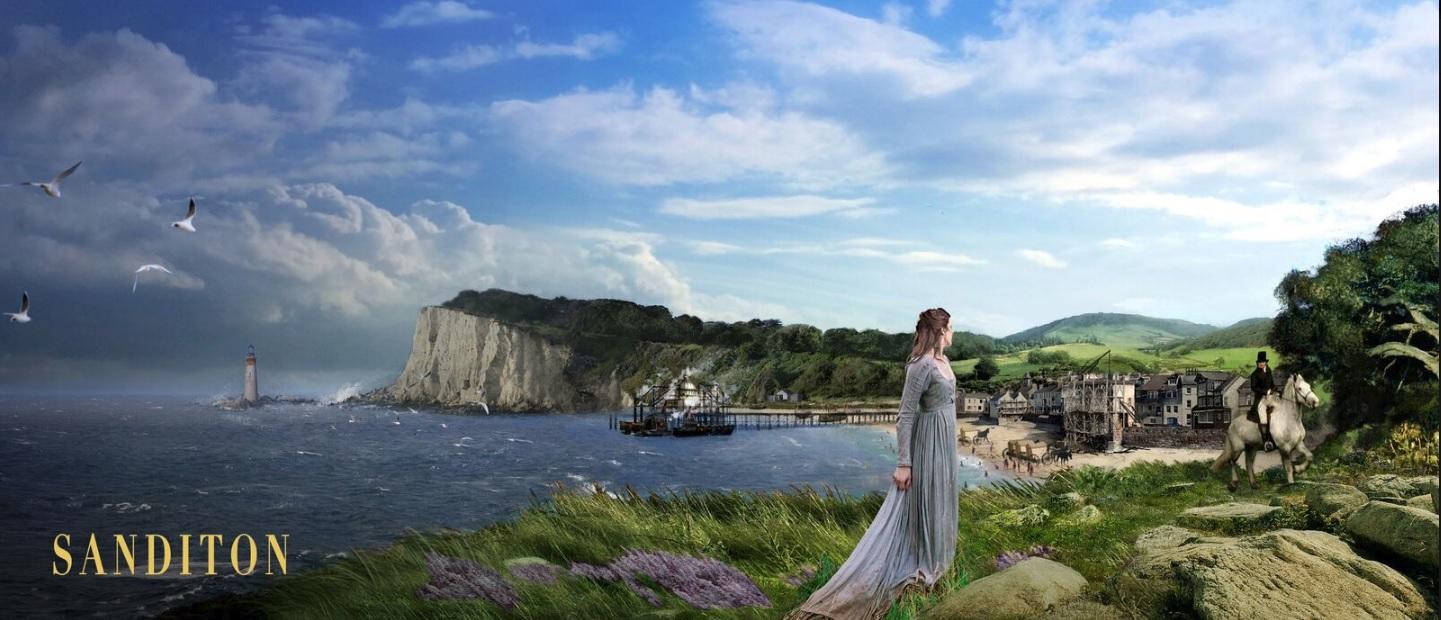
Sanditon starts filming


Another romantic drama from the Regency period -- focussing (again!) on a young woman's quest for love and security.....

Construction of a major outdoor film set is underway at PG company affiliate and Bristol's, The Bottle Yard Studios, for the latest high-end TV drama to shoot at the Studios; the upcoming adaptation of the final incomplete novel from Jane Austen, Sanditon. ITV has announced that Rose Williams, Theo James, Anne Reid and Kris Marshall will star in the lavish drama, which has begun filming.   Screenplay is by Andrew Davies.